

Each year, the Internal Revenue Service (IRS) issues a new W-4 tax form, and each year, many people don’t bother to fill it out.
This happens despite the fact that significant things can occur in any given year that might influence how you fill out a W-4 form.
In this article, we’ll provide an overview of the 2026 W-4 form. We’ll show you how to fill out the 2026 W-4, and we’ll walk you through the accompanying worksheets and IRS Withholding Estimator.
All of this knowledge can help anyone complete the form with the most accurate information possible based on their situation.
Why Should You Care About Filling Out a W-4?
Filling out your W-4 accurately means you're less likely to face a large tax bill or receive a huge refund when you file your 2027 tax return. That refund might feel good, but it's money that could have been invested or spent on essential expenses throughout the year instead of sitting with the IRS.
Updating your federal income tax withholding is always optional. However, the IRS recommends that all employees review their W-4 annually, especially if any life changes occurred.
What's New on the 2026 W-4 Form?
If you haven't filled out a W-4 in several years, you'll notice some changes. The [official IRS W-4 form](https://www.irs.gov/forms-pubs/about-form-w-4) for 2026 includes several updates. Here's what's different for 2026:If you haven't filled out a W-4 in several years, you'll notice some changes. The official IRS W-4 form for 2026 includes several updates. Here's what's different for 2026:
Updates to Step 3: Claiming Dependents
Step 3 has minor but important changes:
Sub-steps are now labeled. The two parts of Step 3 are now explicitly called 3(a) and 3(b). Last year they weren't labeled.
Child Tax Credit increased. For Step 3(a), the amount you can claim for each qualifying child under age 17 increased from $2,000 to $2,200 for 2026.
Major Changes to the Deductions Worksheet
The biggest change in the 2026 Form W-4 is the Deductions Worksheet referenced in Step 4(b). This worksheet expanded significantly due to provisions in the One Big Beautiful Bill Act.
The worksheet went from less than half a page to a full page and now includes new steps for estimating:
- Qualified tips
- Qualified overtime compensation
- Passenger vehicle loan interest
- Senior deduction (for those 65 and older)
- Additional itemized deduction limitations
We'll walk through this worksheet line by line later in this guide.
"Exempt from Withholding" Checkbox
If you're tax-exempt, you can now check a box in the new section between Steps 4 and 5. The 2025 form required you to write "Exempt" in a blank space. Now there's a dedicated checkbox.
While the Form W-4 has been finalized for 2026, there are still factors from the One Big Beautiful Bill Act that may require updates to our article, most notably the IRS Tax Withholding Estimator Tool. Watch this space for further updates.
Understanding How Federal Tax Withholding Works
Before filling out the W-4, it helps to understand how the IRS calculates your tax liability.
The IRS uses this process:
- Start with your annual gross income
- Subtract your standard deduction
- The result is your taxable income
- Apply progressive tax brackets to determine your total tax
2026 Standard Deductions:
- Single or Married Filing Separately: $16,100
- Married Filing Jointly or Qualifying Surviving Spouse: $32,200
- Head of Household: $24,150
- Gross Income: $136,000
- Standard Deduction: $16,100
- Taxable Income: $119,900
Your taxable income gets taxed in segments at different rates: 10%, 12%, 22%, 24%, 32%, 35%, and 37%. Only the income in each bracket gets taxed at that rate.
Example: Calculating Annual Tax Liability
Let's say you're single and earn $136,000 in 2026.
Instead of taxing the entire $119,900 at one rate, the IRS taxes portions at different rates. Your W-4 helps your employer calculate how much to withhold from each paycheck so you don't owe a large amount when you file.
How to Fill Out the 2026 W-4 Form: Step-by-Step
All employees must complete Steps 1 and 5. You should only complete Steps 2, 3, and 4 if specific criteria apply to your situation.
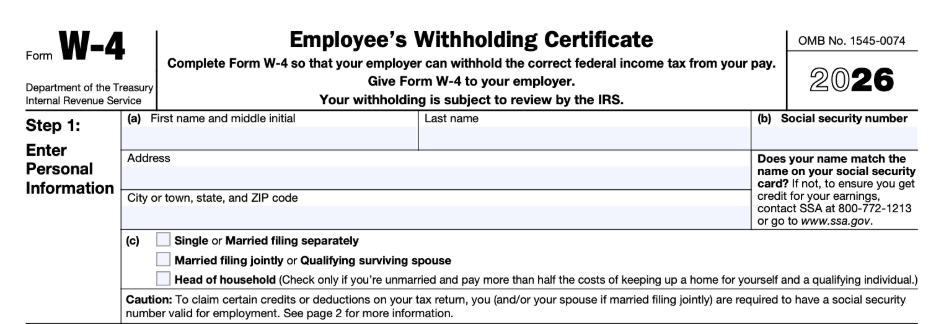
Step 1: Enter Personal Information
Fill out this section with your basic information:
- Full name
- Social Security number
- Address (street, city, state, zip code)
- Tax filing status
Your filing status options:
Single or Married Filing Separately: You're unmarried, or married but filing separate returns
Married Filing Jointly or Qualifying Surviving Spouse: You're married and filing together (typically provides better tax treatment)
Head of Household: You're unmarried, pay more than half the costs of keeping up a home, and have a qualifying dependent
All employees must complete this step. If you don't fill out a W-4, your employer is required to withhold at the "Single" rate, which is the highest withholding rate.
Here’s what it looks like:
Step 2: Multiple Jobs or Spouse Works
The message before Step 2 gives instructions on where to find guidance for any employees who may be exempt from withholding:

Complete this step only if:
- You work more than one job at the same time, OR
- You're married, filing jointly, and your spouse also works
If neither applies, skip to Step 3.
If one of these situations does apply to you, complete Step 2 using one of these three options:
Option A: Use the IRS Tax Withholding Estimator
This provides the most accurate withholding calculation. You'll need:
- Your most recent pay stub
- Your spouse's most recent pay stub(if applicable)
- Your most recent tax return
Important: If you or your spouse has self-employment income, use this option. The estimator handles self-employment income better than the manual worksheet.
Note: As of early 2026, the IRS has not yet updated the Tax Withholding Estimator to reflect the One Big Beautiful Bill Act provisions. Check the IRS website for updates.
Option B: Complete the Multiple Jobs Worksheet
Go to Page 3 of the W-4 to complete this worksheet manually. Enter the result in Step 4(c) of the main form.
This option provides accuracy but requires manual calculation. We'll walk through this worksheet in detail later in this guide.
Option C: Check the Box
If you have only two jobs total (you and your spouse combined), and both jobs have similar pay, check the box in Step 2(c).
This is the easiest option but the least accurate. It assumes both jobs pay roughly the same amount.
Important notes for Step 2:
- Use the information from your highest-paying job when filling out the W-4
- Complete Steps 3 through 4(b) on only one W-4 form (the one for your highest-paying job)
- Your other job(s) should have a W-4 with only Steps 1 and 5 completed
Step 3: Claim Dependents and Other Credits
This section determines your eligibility for the Child Tax Credit and credit for other dependents.

Single taxpayers with a total income of $200,000 or less (or $400,000 if married filing jointly) are eligible for the Child Tax Credit.
If you meet this criterion:
Step 3(a): Qualifying Children Under 17
Multiply the number of qualifying children under age 17 by $2,200.
Example: 2 children under 17 × $2,200 = $4,400
Enter this amount in box 3(a).
Step 3(b): Other Dependents
Multiply the number of other dependents by $500.
Example: 1 dependent age 18 × $500 = $500
Enter this amount in box 3(b).
Line 3: Total Credits
Add 3(a) and 3(b) together and enter the total on line 3.
Example: $4,400 + $500 = $4,900
Who qualifies as a dependent?
For detailed definitions of qualifying children and other dependents, see the Instructions for Schedule 8812 (Child Tax Credit) on the IRS website.
Step 4: Other Adjustments (Optional)
This section allows you to adjust your withholding for other income sources and deductions. All three parts are optional.
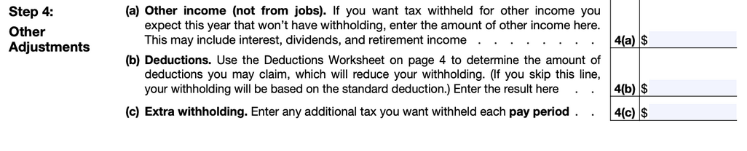
Step 4(a): Other Income (Not from Jobs)
Use this line if you have income that won't have withholding taken out automatically:
- Interest income
- Dividend income
- Retirement income
- Capital gains
Enter the total estimated amount of this other income for the year.
Why include this? If you don't account for other income, you might owe taxes on it when you file. Adding it here increases your withholding to cover that liability.
Step 4(b): Deductions
This line refers to the Deductions Worksheet on Page 4.
If you plan to claim deductions beyond the standard deduction, complete the Deductions Worksheet and enter the result here.
If you skip this line: Your withholding will be based only on the standard deduction for your filing status.
The Deductions Worksheet is significantly more detailed for 2026. We'll walk through it line by line in the next section.
Step 4(c): Extra Withholding
Enter any additional amount you want withheld from each paycheck.
When to use this:
- You consistently owe money at tax time
- You want a larger refund
- You completed the Multiple Jobs Worksheet (enter the result from that worksheet here)
- You want to withhold for income not covered elsewhere
Example: If you enter $50 here, your employer will withhold an extra $50 from each paycheck beyond the calculated federal tax.
Step 5: Sign and Date
This step is mandatory. The form is invalid without your signature.
Review all information you entered, then sign and date the form.
If you don't sign the form, your employer must disregard it and withhold at the "Single" rate.
When to submit a new W-4:
You can update your W-4 anytime your situation changes:
- Marriage or divorce
- Birth or adoption of a child
- Starting or ending a second job
- Your spouse starting or stopping work
- Buying a home (if you'll itemize deductions)
- Any other significant life or financial change
Worksheets on Form W-4
Just as it has been over the past few years, the 2026 Form W-4 has only two worksheets. We’ll cover both here so you can understand when employees should use them.
The Multiple Jobs Worksheet: Line-by-Line Instructions
If you chose Option B in Step 2, complete this worksheet on Page 3 of the W-4.
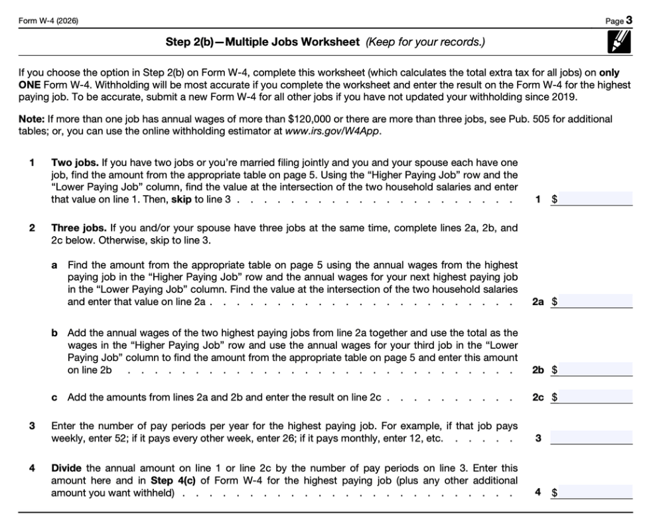
Line 1: Two Jobs Total
Complete this line if you have two jobs total (either two jobs yourself, or one job while your spouse also has one job).
How to complete:
- Turn to Page 5 and find the table that matches your filing status:
- Married Filing Jointly or Qualifying Surviving Spouse
- Single or Married Filing Separately
- Head of Household
- Find your "Higher Paying Job" wages in the left column
- Find your "Lower Paying Job" wages in the row across the top
- The number where these intersect goes on Line 1.
Example: You earn $94,000 at Job A. Your spouse earns $42,000 at Job B. You're married filing jointly. Find where $90,000-$99,999 (left column) intersects with $40,000-$49,999 (top row). Enter that amount on Line 1.
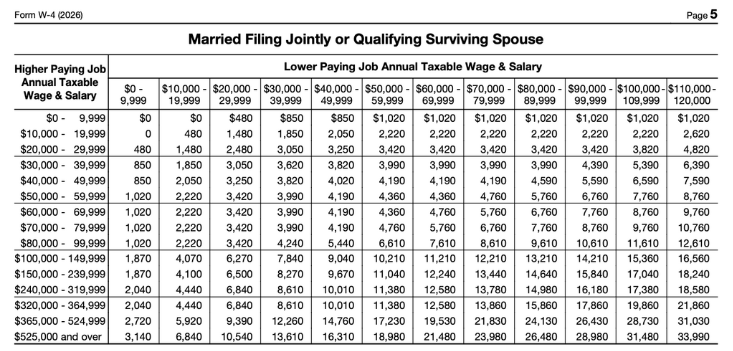
Note: that the screengrab above is the table for taxpayers who are married filing jointly or a qualifying surviving spouse. There is a separate table for single and married taxpayers filing separately, and another one for taxpayers filing as head of household. Be sure you’re using the right table.
Lines 2a-2c: Three Jobs Total
Complete these lines if you have three jobs combined between you and your spouse.
Line 2a: Two Highest-Paying Jobs
- Find your highest-paying job wage in the left column
- Find your second-highest-paying job wage in the top row
- Enter the amount where they intersect on Line 2a
- Add the wages from your two highest-paying jobs together
- Find that combined amount in the left column
- Find your third job's wages in the top row
- Enter the amount where they intersect on Line 2b
Line 2b: Combined High Jobs vs. Third Job
- Add the wages from your two highest-paying jobs together
- Find that combined amount in the left column
- Find your third job's wages in the top row
- Enter the amount where they intersect on Line 2b
Line 2c: Total for Three Jobs
Add Line 2a and Line 2b. Enter the total on Line 2c.
Line 3: Pay Periods Per Year
Enter the number of pay periods per year for your highest-paying job:
- Weekly: 52
- Every other week: 26
- Twice a month: 24
- Monthly: 12
Line 4: Withholding Per Pay Period
Divide Line 1 (or Line 2c if you have three jobs) by Line 3.
Enter this amount on Line 4 and in Step 4(c) on Page 1 of the W-4.
This is the additional amount that will be withheld from each paycheck to account for your multiple jobs.
The Deductions Worksheet: Complete Guide for 2026
Now, let’s talk about the BIG change in the 2026 form: Step 4b, Deductions.
Step 4b sends you to the Deductions Worksheet on page 4. The Deductions Worksheet itself is not new, but it is a lot more involved than the 2025 form. The 2025 Form only had 5 lines and took up about a quarter of the page.
The 2026 Deductions Worksheet covers the new deductions from the One Big Beautiful Bill Act and now takes up an entire page and has 15 steps.
Have your prior-year tax return available when completing this worksheet. It will help you estimate your deductions for 2026.
We’re going to go through it, line by line together. Here we go.
Lines 1a-1c and Line 2: New OBBB Deductions
These lines cover three new deductions from the One Big Beautiful Bill Act.
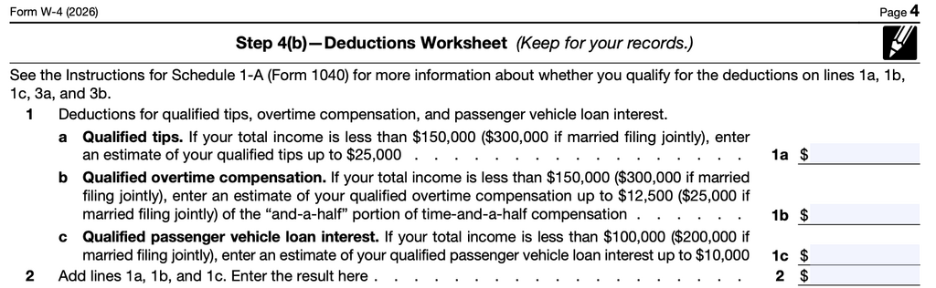
Line 1a: Qualified Tips
If you expect income less than $150,000 ($300,000 if married filing jointly):
Enter an estimate of your qualified tips, up to $25,000.
Qualified tips are tip income you receive from customers that's reported to your employer.
Line 1b: Qualified Overtime Compensation
If you expect income less than $150,000 ($300,000 if married filing jointly):
Enter an estimate of the "and-a-half" portion of your time-and-a-half overtime pay.
Maximum amounts:
- Single filers: $12,500
- Married filing jointly: $25,000
Example: If you earned $30 per hour regular pay and $45 per hour for overtime, the "and-a-half" portion is $15 per hour. If you worked 100 overtime hours, your qualified overtime would be $1,500 (100 × $15).
Line 1c: Qualified Passenger Vehicle Loan Interest
If your income is less than $100,000 ($200,000 if married filing jointly):
Enter an estimate of the interest you'll pay on a passenger vehicle loan, up to $10,000.
This applies to loans taken out to purchase a car for personal use.
Line 2: Total OBBB Deductions
Add Lines 1a, 1b, and 1c. Enter the total on Line 2.
If none of these apply to you, enter zero and continue to Line 3.
Lines 3a-3b and Line 4: Senior Deduction
These lines apply if you or your spouse will be 65 or older by the end of 2026.

Line 3a: Your Age 65+ Deduction
If you will be 65 or older, enter $6,000 on Line 3a.
If you will not be 65 or older, enter zero.
Line 3b: Spouse Age 65+ Deduction
If your spouse will be 65 or older, enter $6,000 on Line 3b.
If not applicable or you're not married, enter zero.
Line 4: Total Senior Deductions
Add Lines 3a and 3b. Enter the total on Line 4.
Line 5: Adjustments to Income
Enter your estimated total for "above the line" deductions from Schedule 1 of Form 1040.
Common adjustments include:
- Student loan interest
- Deductible IRA contributions
- Educator expenses (for teachers)
- Alimony paid
- Health Savings Accountcontributions
Your prior-year tax return (Schedule 1) shows what you claimed last year. Adjust up or down based on expected changes for 2026.
Lines 6a-6e and Line 7: Itemized Deductions
Complete these lines if you plan to itemize deductions instead of taking the standard deduction.
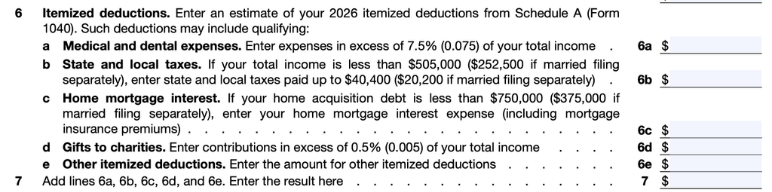
Line 6a: Medical and Dental Expenses
Enter estimated medical and dental expenses that exceed 7.5% of your adjusted gross income.
Only the amount above the 7.5% threshold is deductible.
Line 6b: State and Local Taxes
Enter estimated state and localtaxes, up to $10,000.
This includes:
- State income tax
- Local income tax
- Property taxes
- Sales tax (if you're claiming itinstead of income tax)
The $10,000 cap applies whetheryou're single or married filing jointly.
Line 6c: Home Mortgage Interest
Enter the estimated mortgage interest you'll pay in 2026.
This includes interest on yourprimary residence and, if applicable, a second home.
Line 6d: Gifts to Charity
Enter estimated charitablecontributions you'll make in 2026.
Include:
- Cash donations
- Fair market value of donated items
- Mileage driven for charitablepurposes
Line 6e: Other Itemized Deductions
Enter other allowable itemizeddeductions.
This might include:
- Casualty and theft losses fromfederally declared disasters
- Gambling losses (up to gamblingwinnings)
Line 7: Total Itemized Deductions
Add Lines 6a through 6e. Enter thetotal on Line 7.
Lines 8a-8b: Income Calculation

Line 8a: Expected Income
Enter your expected total incomefor 2026.
Use your prior-year income as astarting point, then adjust for expected raises, bonuses, or changes.
Line 8b: Income Minus Senior Deduction
Subtract Line 4 from Line 8a. Enterthe result on Line 8b.
This shows your income afteraccounting for any senior deduction.
Lines 9 and 10: Itemized Deduction Limitation
The One Big Beautiful Bill Act limits the benefit of itemized deductions for high earners in the top taxbracket.
Line 9: Income Threshold
Enter the amount that applies to your filing status:
- Single: $640,600
- Married Filing Separately: $384,300
- Married Filing Jointly orQualifying Surviving Spouse: $768,600
- Head of Household: $704,600
Line 10: Limited or Full Itemized Deductions
If Line 9 is greater than Line 8b:
Your itemized deductions are not limited. Enter the amount from Line 7 on Line 10.
If Line 8b is greater than Line 9:
Your itemized deductions are limited. Multiply Line 7 by 0.94 (94%). Enter that result on Line 10.
Example: Line 7 shows $30,000 initemized deductions. Line 8b is greater than Line 9. Multiply $30,000 × 0.94 =$28,200. Enter $28,200 on Line 10.
Lines 11-13: Standard Deduction Comparison

Line 11: Standard Deduction
Enter the standard deduction for your filing status:
- Single or Married Filing Separately: $16,100
- Married Filing Jointly or Qualifying Surviving Spouse: $32,200
- Head of Household: $24,150
Line 12: Senior Standard Deduction Addition
Enter the applicable amount:
- Single or Head of Household: $1,000
- Married Filing Jointly or Qualifying Surviving Spouse: $2,000
This additional amount applies if you're 65 or older (or if your spouse is 65 or older).
Line 13: Total Standard Deduction
Add Lines 11 and 12. Enter the total on Line 13.
Line 14: Net Deductions

Compare Lines 10 and 13 to see which is greater.
If Line 10 is greater than Line 13:
Your itemized deductions exceed your standard deduction. Subtract Line 11 from Line 10. Enter the result on Line 14.
If Line 13 is greater than Line 10:
Your standard deduction exceeds your itemized deductions. Enter the amount from Line 12 on Line 14.
Line 15: Total Deductions for Step 4(b)
Add Lines 2, 4, 5, and 14 together.
Enter this total on Line 15 and in Step 4(b) on Page 1 of the W-4.
This is the total amount of deductions that will reduce your withholding.
Do You Need to Fill Out a W-4 in 2026?
Okay, so who actually needs to fill out a W-4 form in 2026?
Just like every other year, the short answer is: It depends.
Here’s a list of questions to ask yourself to know:
- Are you married? If yes, does your spouse work?
- Do you or your spouse have a second job?
- Do you have any new dependents?
- Is there a chance that you won’t use the standard deduction?
- Did you get a large tax bill or have a large refund last year?
If you answer “Yes” to any of those questions, then we recommend revisiting your W-4.
If you're hired in 2026, then you must complete a W-4 form. There's no exception.
Using the IRS Tax Withholding Estimator
The IRS offers a Tax Withholding Estimator tool online to help you complete your W-4 accurately without doing manual calculations.
Important: As of early 2026, the IRS has not yet updated the Tax Withholding Estimator to reflect the One Big Beautiful Bill Act provisions. Check back on the IRS website for updates.
When the tool is updated, you'll need:
- Your most recent pay stub (showing year-to-date earnings and federal tax withheld)
- Your most recent tax return
- Your spouse's most recent pay stub (if married and filing jointly)
The estimator will calculate your expected tax liability for 2026 and tell you how to adjust your W-4 to achieve your desired outcome (refund, break even, or specific withholding amount).
The estimator is only as accurate as the information you enter. Don't guess at numbers. Use actual figures from your pay stubs and tax return.
Who Should Use the Tax Withholding Estimator?
The IRS particularly recommends using the estimator if you:
- Are 65 or older
- Have income from tips or overtime
- Paid interest on a vehicle loan
- Paid more than $10,000 in state and local taxes
- Work two jobs or work while your spouse also works
- Have children and claim the Child Tax Credit
- Itemized deductions last year
- Have a high income with a complex tax situation
Tips for Maximizing Accuracy
Use your prior-year tax return: It's the best starting point for estimating deductions, credits, and income for the current year.
Update mid-year if needed: If something significant changes in July, don't wait until next January. Submit a new W-4 right away so your withholding adjusts for the remaining months.
Check your first paycheck: After submitting a new W-4, verify that your withholding changed as expected. If it doesn't look right, contact your payroll department.
Consider your refund preference: Some people like large refunds (forced savings). Others prefer breaking even (money available throughout the year). Neither is wrong. Choose the approach that works for your financial habits.
Don't forget state withholding: The W-4 only affects federal taxes. If your state has income tax, check if you need to complete a state withholding form as well.
Common W-4 Mistakes to Avoid
Skipping Step 2 when it applies: If you work multiple jobs or your spouse works, you must complete Step 2. Skipping it means you'll likely owe money at tax time.
Claiming dependents on multiple jobs: Only claim dependents on one W-4 (the one for your highest-paying job). Don't claim them on W-4s for other jobs.
Not updating after life changes: Marriage, divorce, new children, and job changes all affect your taxes. Update your W-4 when these happen.
Forgetting to sign: An unsigned W-4 is invalid. Your employer will withhold at the Single rate, which may be wrong for your situation.
Using last year's form: Always use the current year's W-4. The form changes annually.
For more answers to common paycheck questions, read: Top 5 Questions Employees Ask about Their Paychecks.
What Happens After You Submit Your W-4
Your employer will use your W-4 to calculate federal income tax withholding for each paycheck. They'll also keep the form on file.
You should see the withholding change reflected on your next paycheck (or the paycheck after that, depending on your employer's payroll cycle).
If you don't see the expected change, contact your payroll or HR department. There may have been an error in processing your form.
Your employer will continue using this W-4 until you submit a new one. The form doesn't expire, but your situation might change, requiring an update.
You Just Did What Most People Avoid: Actually Understanding Your W-4!
Most people see the W-4, panic, check 'Single' or 'Married', skip everything else, and hope for the best... Then they complain when they owe $2,000 in April or realize they gave the government an interest-free loan all year.
You didn't! You worked through the Multiple Jobs Worksheet. You figured out qualified tips, vehicle loan interest, and itemized deduction limitations. You made it through fifteen lines on the Deductions Worksheet.
That was a lot, so if you're still not sure about something, that's okay. Use the IRS Tax Withholding Estimator when it updates for 2026. Or talk to a tax preparer. Your employer will process whatever W-4 you give them, but they can't tell you how to fill it out. That's not their responsibility.
Here's what you need to remember: the W-4 controls one thing. How much federal tax comes out of your paycheck. Everything else on your pay stub - Social Security, Medicare, state taxes - happens regardless of what you put on this form.
But federal withholding? That's yours to control. And now you know how!
