
Do your employees often question why their paychecks seem smaller than expected?
You want to help them understand why, but at the same time, you don't want to accidentally say something wrong about taxes. That’s a pretty normal spot for employers to be in.
Paycheck withholdings are one of the most common sources of frustration and confusion in the workplace. When employees don't understand where their money is going, it can lead to mistrust and stress (two things that directly impact retention and morale).
This guide will help you understand the three types of taxes that come out of every single paycheck, how they're calculated, and what changed in 2026 that might affect what you're seeing. By the end, you'll know exactly what to say the next time someone walks up with that "my paycheck is wrong" look on their face.
These figures reflect the 2026 tax year, which applies to wages earned during 2026 and will be reported when taxes are filed in 2027.
The Different Types of Taxes on a Paycheck
A typical paycheck includes deductions for several kinds of taxes, generally in three main categories:
- Social Security and Medicare (FICA)
- Federal Income Tax Withholding
- State and Local Tax Withholding
The tax liability for each category is calculated differently, and if you don’t know how each one works, the amounts you see can be confusing. Let’s take a closer look at each category.
1. Social Security and Medicare (FICA) Taxes
FICA stands for Federal Insurance Contributions Act. These are mandatory federal taxes that fund Social Security retirement benefits and Medicare healthcare coverage. Every employee pays the same rates, regardless of income level:
Standard FICA Rates:
- Social Security: 6.2% of gross wages
- Medicare: 1.45% of gross wages
- Combined rate: 7.65% of each paycheck
Example: An employee earning $1,000 gross pay will have $76.50 deducted for FICA taxes.
2026 Social Security Wage Base
The Social Security portion of FICA has an annual wage cap. For 2026, that cap increased to $184,500 (up from $176,100 in 2025).
What this means: Once an employee's total wages for the year reach $184,500, they stop paying Social Security tax for the rest of the year. The maximum Social Security tax an employee can pay in 2026 is $11,439.
Important to note: Medicare tax has no wage cap. Employees pay 1.45% on all wages throughout the year.
Additional Medicare Tax
Employees earning over $200,000 annually pay an additional 0.9% Medicare tax on wages above that threshold. This brings their total Medicare rate to 2.35% on earnings over $200,000.
Employer Matching
Employers match every dollar employees pay into FICA. If your employee paid $76.50 in FICA taxes, you paid $76.50 as well. This is why total payroll costs exceed the gross wages you agreed to pay.
2. Federal Tax Withholdings
Federal withholding is the estimated federal income tax taken from each paycheck based on an employee's W-4 form. Unlike FICA's fixed percentage, federal withholding varies by employee based on several factors:
- Filing status (single, married filing jointly, head of household)
- Annual income projection
- Number of dependents
- Additional withholding requests
How the W-4 Form Works
When employees complete Form W-4 during onboarding, they're telling your payroll system how much federal tax to withhold. The form affects only federal income tax withholding - it doesn't change FICA or state/local taxes.
Understanding Refunds vs. Tax Bills
The amount withheld determines whether an employee gets a refund or owes money at tax time:
Larger withholding = Larger refund
- Employees who want bigger refunds can claim "single" with zero dependents, even if they're married with children
- More tax comes out each paycheck
- Results in a larger refund when filing taxes
Accurate withholding = Break even
- Employees who complete the W-4 based on their actual filing status typically break even at tax time
- Federal taxes are covered throughout the year
- Little to no refund or bill when filing
Both approaches are valid; it depends on personal financial preference. If employees have questions about optimizing their W-4, direct them to consult a tax professional.
How Federal Taxes Are Calculated
While payroll software or services usually perform these calculations automatically, it helps employees to understand that tax withholdings are essentially pre-payments on future tax liability.
Federal tax withholding is based on:
- Annualized income (total expected earnings for the year)
- Standard deduction for the employee's filing status
- Resulting taxable income
2026 Standard Deductions
The standard deduction is the amount of income exempt from federal taxation:
- Single or Married Filing Separately: $16,100
- Married Filing Jointly: $32,200
- Head of Household: $24,150
These increased amounts reflect annual inflation indexing.
The IRS also uses updated tax brackets for 2026 to determine how much tax is owed at each income level, with rates ranging from 10% up to 37%. Higher earnings are taxed at higher rates, but only on the income within each bracket.
3. State and Local Tax Withholdings
Finally, the last tax that you will see on your check stub is the State and Local taxes.
State and local tax requirements vary significantly by location. Each state has its own calculation rules, and some jurisdictions add city, county, or school district taxes on top of state taxes.
State-Specific Requirements
Tax requirements depend on your business location:
- Some states have no income tax
- Some states have flat tax rates
- Some states use progressive tax brackets similar to federal taxes
- Some cities and counties impose additional local taxes
For detailed information on your specific state's requirements, reference the state tax administrators' resource list.
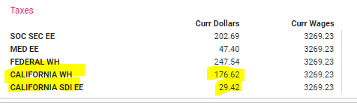
As an example, here in Tennessee, there’s no state income tax on wages, which means employees don’t see a state income tax withholding on their pay stubs. However, local taxes or other deductions still apply (such as city occupational taxes in specific municipalities).
Payroll System Configuration
Your payroll software calculates state and local taxes automatically based on the location information entered during employee setup. Verify that each employee's work location is correctly configured in your system to apply the proper tax rates.
How to Help Your Employees Make Sense of Their Paychecks
Understanding tax withholdings doesn’t come naturally to most people, and that’s okay.
As an employer, your job is to give them enough clarity that they trust the process and feel confident in how their compensation is handled.
The more transparent and educational you are about paycheck withholdings, the more empowered your employees will feel.
When people feel informed about where their money is going and why, it reduces stress, increases confidence, and strengthens their connection to your company. In a competitive job market, those small moments of clarity can make a big difference in long-term satisfaction and retention.
Your Next Step Keeping Their Paychecks Safe
You know what gets taken out of paychecks now. But what about protecting what actually hits their bank account?
Direct deposit scams are getting more common and harder to spot right off the bat. Help your team protect their hard-earned income by understanding how paycheck-related scams work and ways to prevent them before they cause damage.
Read How to Avoid Direct Deposit Scams to learn what scams look like, how they work, and what to tell your team so they don't fall for them.
