
The Short Version
HR compliance mistakes are some of the most expensive errors a small business can make, and most of them are preventable. The six that put businesses most at risk are: misclassifying employees, poor recordkeeping, discrimination and harassment, wage and hour violations, improper terminations, and immigration (Form I-9) errors. Penalties range from per-violation fines to back taxes and damages that can climb into five or six figures, on top of legal fees, back pay, and reputational damage. We’ll walk through what each mistake actually costs and the specific steps that protect your business.
When someone mentions "Human Resources," most business owners immediately picture compliance, and for good reason. Falling short here is more than an administrative headache. It can drain your cash, tie up your time in legal battles, and damage a reputation you spent years building.
At Whirks, we work with small business owners across Memphis and beyond who are juggling a dozen responsibilities at once, and HR compliance is rarely the thing they trained for. We’ve seen a single overlooked I-9 form or one misclassified worker turn into a problem that costs thousands to fix. Most of the time, the owner had no idea they were exposed until an audit or a complaint forced the issue.
This article walks you through the six most common HR compliance pitfalls we see, what each one can actually cost, and the practical steps that protect your business.
What HR Compliance Mistakes Cost: A Quick Comparison
Before we get into each one, here's a side-by-side look at what these six mistakes can cost and how exposed the average small business is.
|
HR Compliance Mistake |
Potential Penalty |
Who's Most at Risk |
|
Employee misclassification |
Significant IRS back taxes and penalties per misclassified worker (often tens of thousands of dollars over several years), plus back pay, benefits, and potential class-action exposure; criminal charges are possible in deliberate tax-evasion or fraud cases. |
Businesses heavily using 1099 contractors or misclassifying salaried staff as exempt from overtime. |
|
Poor recordkeeping |
Civil penalties for specific recordkeeping failures (such as I‑9 paperwork violations per employee), plus weak defenses in audits and lawsuits that can dramatically increase back‑pay awards and other penalties. |
Businesses without a consistent system for personnel, payroll, and I‑9 files. |
|
Discrimination & harassment |
Compensatory and punitive damages capped by federal law (up to hundreds of thousands of dollars depending on employer size), plus uncapped back pay/front pay, attorney’s fees, and court orders to change practices. |
Any employer with supervisors; liability can be vicarious when managers harass or discriminate. |
|
Wage & hour violations |
Back wages and “double damages,” civil money penalties that can reach hundreds or thousands of dollars per violation, much higher fines for child‑labor violations, and possible criminal prosecution for willful or repeat offenders. |
Restaurants, retail, salons, home‑care agencies, and any business with hourly or tipped workers. |
|
Improper termination |
Lost wages and benefits, reinstatement or front pay, emotional‑distress damages, and attorney’s fees under federal and state wrongful‑termination and retaliation laws. |
Every employer, even in at‑will states where illegal reasons for termination are still prohibited. |
|
Immigration (I-9) errors |
Civil fines per I‑9 paperwork or hiring violation (ranging from hundreds to several thousand dollars per worker and periodically adjusted), and for patterns or practices of hiring unauthorized workers, potential criminal charges, imprisonment, and limits on sponsoring foreign workers. |
Every U.S. employer that hires employees, whether the worker is a citizen or not. |
Sources: IRS, U.S. Department of Labor, EEOC, USCIS/ICE, and federal immigration statutes. Figures reflect current federal penalties and may be higher under state law.
Even one slip in these areas can snowball into five‑ or six‑figure liability, so a basic HR compliance checkup is far cheaper than waiting for a complaint.
6 HR Compliance Mistakes That Could Sink Your Business
When it comes to HR compliance, even small oversights can lead to significant consequences. Let's start with the one that trips up as many as 30% of employers.
1. Why Employee Misclassification Is One of the Costliest HR Mistakes
Did you know that up to 30% of employers have misclassified at least one employee? That seemingly small administrative detail carries enormous weight.
Whether you’re designating someone as exempt vs. non-exempt or employee vs. independent contractor, getting it wrong has serious ripple effects for both you and your team.
We see this most often as employees treated as exempt from overtime who don't actually meet the legal criteria. The assumption is that a "manager" title or a salary automatically makes someone exempt, but the FLSA's exemption tests look at actual job duties, not just title and pay.
We started working with a client who had been treating several employees as exempt for years, and when we reviewed the real job duties and pay structure, they didn't qualify. No one had caught it, not their accountant and not their previous payroll provider. Correcting it meant reclassifying roles and restructuring pay, and the back-pay exposure was significant.
The other version is contractor misclassification: a business brings someone on as a 1099 contractor, but the working relationship looks much more like a W-2 employee. The IRS and DOL both have criteria for this, and the biggest factor is control. If you dictate when, where, and how the work gets done, that person is probably an employee, no matter what the agreement says.
What’s at stake:
- IRS back taxes and penalties that can reach tens of thousands of dollars per misclassified employee, and far more in large or willful cases
- Class-action lawsuits from affected workers
- Back pay for missed overtime, benefits, and taxes
- Potential jail time for intentional misclassification
- A damaged reputation that makes recruiting top talent nearly impossible
The distinction between exempt and non-exempt isn’t just paperwork. It determines whether an employee is entitled to overtime pay under the Fair Labor Standards Act (FLSA). Classifying someone as a 1099 contractor when they should be a W-2 employee means they’re missing out on benefits, tax withholding, and consistent paychecks.
Proper classification is only part of the picture, though. Even when you've classified every employee correctly, your documentation practices could still put you at risk during an audit or investigation.
2. When Poor Recordkeeping Becomes Your Biggest Liability
“If it’s not documented, it didn’t happen” might as well be the motto of HR recordkeeping. Your business is legally required to maintain accurate records of employee information, including hours worked, wages paid, and benefits provided.
The three essential types of files you must maintain properly are:
- Personnel files (including I-9 forms)
- Payroll records
- Medical files
Key retention requirements:
- I-9 forms: keep for three years after hire or one year after termination (whichever is longer)
- Payroll records: Minimum of two years
- Work schedules and wage rate tables: two years
The EEOC has specific recordkeeping requirements that vary by document type. Missing or incomplete records can leave you defenseless during an audit or legal dispute. It's also worth knowing that medical files must stay separate from the general personnel file; mixing them is its own compliance violation.
When we run an HR review for a new client, this is consistently where we find gaps. Missing I-9 forms, incomplete W-4s, no signed acknowledgment of the employee handbook, performance conversations that happened verbally but were never written down, terminations with no documentation trail. These things aren’t unusual, and they tend to happen when HR responsibilities get spread across people who already have full-time jobs. And the risk shows up in two places: during an audit, when the absence of a record becomes the problem, and during a dispute, when the first question anyone asks is "what's in the file?"
Documentation alone can't shield your business from every risk, though. Your paperwork might be flawless, but it won't protect you if your workplace culture allows harmful behavior.
3. How Discrimination and Harassment Lawsuits Could Cost You Millions
Workplace discrimination and harassment issues can devastate both your employees and your business. The EEOC defines harassment as unwelcome conduct based on:
- Race or color
- Religion
- Sex (including sexual orientation, gender identity, or pregnancy)
- National origin
- Age (40 or older)
- Disability
- Genetic information (including family medical history)
Discrimination in the workforce can fall into the same categories. And even if the behavior happens at a supervisory level rather than company-wide, your business can still be held vicariously liable.
Potential consequences:
- Compensatory and punitive damages (with limits based on company size)
- Attorney’s fees, expert witness costs, and court expenses
- Back pay and job placement requirements
- Severe reputational damage
Prevention is everything here. Clear policies, regular training, and swift action when issues arise protect both your employees and your business.
Discrimination lawsuits can be financially and reputationally devastating, but they aren't the only legal landmine employers face. Wage and hour violations rarely make headlines, yet they drain resources and erode trust just as effectively.
4. How Wage and Hour Law Violations Drain Your Resources
The FLSA governs everything from minimum wage to overtime pay, and violations add up fast. Even minor oversights, like missing required workplace posters in high-traffic areas or miscalculating overtime, can trigger costly investigations.
The one we see catch businesses most often is overtime for tipped employees. Calculating overtime for a server who earns a tipped wage plus tips, especially when that person also works a non-tipped role during the same week, is genuinely complicated, and it's one of the most common ways a restaurant ends up owing back wages. (If that's your situation, we break the math down in detail in tipped employee overtime explained for restaurants.)
Key areas to monitor include:
- Paying at least federal or state minimum wage (whichever is higher)
- Correctly calculating and paying overtime
- Documenting and paying for all hours worked
- Maintaining accurate records
- Following child labor regulations
Potential penalties:
- Payment of back wages, often with an equal amount in liquidated ("double") damages
- Civil money penalties per violation for repeat or willful offenders
- Substantially higher penalties for child labor violations, with the steepest fines reserved for violations that cause a minor's death or serious injury
- Potential criminal prosecution, including fines and imprisonment for willful violations
Compliance with wage and hour laws is a legal obligation that affects every employer, regardless of size.
Paying employees correctly matters, but so does following proper procedure when employment ends. Your pay practices might be flawless, but the moment you need to let someone go, many businesses unknowingly create serious legal exposure.
5. Why Improper Terminations Lead to Costly Legal Battles
“You’re fired!” might be easy to say on reality TV, but in the real business world, improper termination can have serious legal and financial consequences.
While all states, except Montana are “at-will” employment states (meaning employees can generally be terminated for any reason that’s not illegal), at-will doesn’t give employers unlimited freedom. Terminating an employee incorrectly can lead to wrongful termination claims and substantial penalties.
Common improper termination scenarios include:
- Discriminatory firings based on protected characteristics
- Retaliatory terminations for reporting illegal activities or exercising legal rights
- Terminations that violate employment contracts
- Quid pro quo situations (“Do this, or you’re fired.”)
What improper termination could cost you:
- Lost wage payments from the termination date
- Compensation for wage differences between prior and new employment
- Reimbursement for benefits lost due to termination
- Coverage of job search expenses
- Damages for emotional distress if the employee experienced a hostile work environment
- Legal fees and court costs that can quickly escalate
Even in at-will states, wrongful termination lawsuits can cost your business thousands. Proper documentation, consistent application of your policies, and fair treatment are what protect you. This is exactly why the recordkeeping from mistake #2 matters so much: When a termination is challenged, your documentation is your defense.
There's one more area of compliance that affects every single new hire, regardless of position or pay, and it carries some of the most severe penalties on this list.
6. How Immigration Compliance Mistakes Can Shut Down Your Business
Every U.S. employer must verify employment eligibility by properly completing Form I-9 for every person hired, including citizens and non-citizens.
This is the area where the rules have changed the most recently. In March 2026, ICE quietly updated its Form I‑9 inspection fact sheet and reclassified a long list of common mistakes that used to be treated as correctable “technical” errors as substantive violations. The kind that can trigger fines right away instead of a 10‑day fix‑it period. At the same time, ICE’s rate of I‑9 audits has surged, with some reports showing that Notices of Inspection in 2025 were roughly 10 times higher than in 2024 and that enforcement pressure has remained high into 2026. So even if your I‑9 process looked fine a year or two ago, it is absolutely worth a fresh review under the new rules.
Immigration compliance mistakes can lead to:
- Civil fines per form for paperwork violations under the Immigration Reform and Control Act, ranging from hundreds to several thousand dollars per worker and periodically adjusted for inflation
- Substantially higher per-worker fines for knowingly hiring or continuing to employ unauthorized workers
- Criminal penalties for a pattern or practice of violations
- Loss of the ability to sponsor or hire foreign workers
Because fines are assessed per form, a stack of small errors across your team can add up to five- or six-figure exposure fast. Proper I-9 verification means following federal requirements meticulously and keeping a consistent process across every hire and every location.
 Why HR Compliance Matters More Than You Think
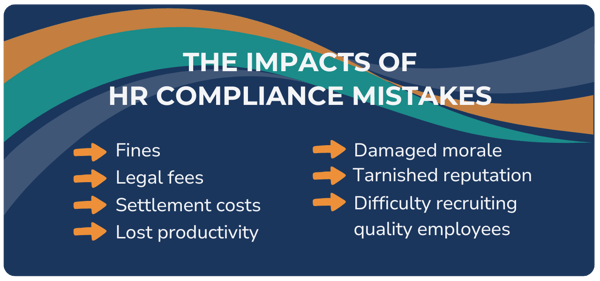
The financial impact of HR compliance mistakes goes well beyond the immediate fine. Consider the compound effect:
- Legal fees
- Settlement costs
- Lost productivity
- Damaged morale
- Tarnished reputation
- Difficulty recruiting quality employees
For many small businesses, a single significant compliance penalty can mean the difference between growth and going under. That's why we’d rather see an owner spend a few hours building a clean process now than spend months and thousands of dollars cleaning up later.
Frequently Asked Questions About HR Compliance
What is HR compliance? HR compliance means following the federal, state, and local laws that govern how you hire, pay, manage, and terminate employees. It covers classification, recordkeeping, anti-discrimination, wage and hour rules, terminations, and employment eligibility verification.
What are the most common HR compliance mistakes for small businesses? The six covered here are the ones we see most: misclassifying employees, poor recordkeeping, discrimination and harassment, wage and hour violations, improper terminations, and I-9 errors. Misclassification and wage/hour issues tend to be the most expensive for small businesses.
How long do I have to keep employee records? It depends on the document. I-9 forms must be kept three years after hire or one year after termination, whichever is longer. Payroll records and work schedules generally must be kept for at least two years. Always check your state's rules, which can require longer.
Do small businesses really get audited for HR compliance? Yes. Wage and hour investigations, EEOC complaints, and I-9 audits all affect small businesses, not just large ones. Many investigations start with a single employee complaint rather than a random audit.
Can I outsource HR compliance? Yes. Many small businesses work with an HR partner to handle classification, recordkeeping, policy, and compliance monitoring so they aren't trying to track every regulation themselves. That's a core part of what our People Services team does at Whirks.
Take the Guesswork Out of HR Compliance
Staying on top of HR regulations shouldn't keep you up at night. You started your business to focus on what you do best, not to become an expert in employment law.
These six mistakes (misclassification, recordkeeping, discrimination and harassment, wage and hour violations, improper terminations, and I-9 errors) are the ones most likely to cost a small business real money. The good news is that every one of them is preventable once you know where your exposure is, and most of these gaps are fixable long before they turn into penalties.
The hard part is that most of these risks stay invisible until something forces them into the open. So if reading through these six has you wondering where your own business might be exposed, the best thing you can do is to get specific about it.
We pulled together the gaps we see most often when we review a company's HR setup, the ones owners are usually surprised to find: Hidden HR Risks Most Small Businesses Don't Realize They Have. It's a practical way to spot what might be hiding in your own files before an audit or a complaint does it for you.
The information provided in this article is for general informational purposes only and should not be construed as legal advice. Always consult with qualified legal counsel for specific guidance related to your business circumstances.
Topics:
